 +1 440-255-8000


Historic Renovation and Adaptive Reuse of Cincinnati’s Union Central Tower
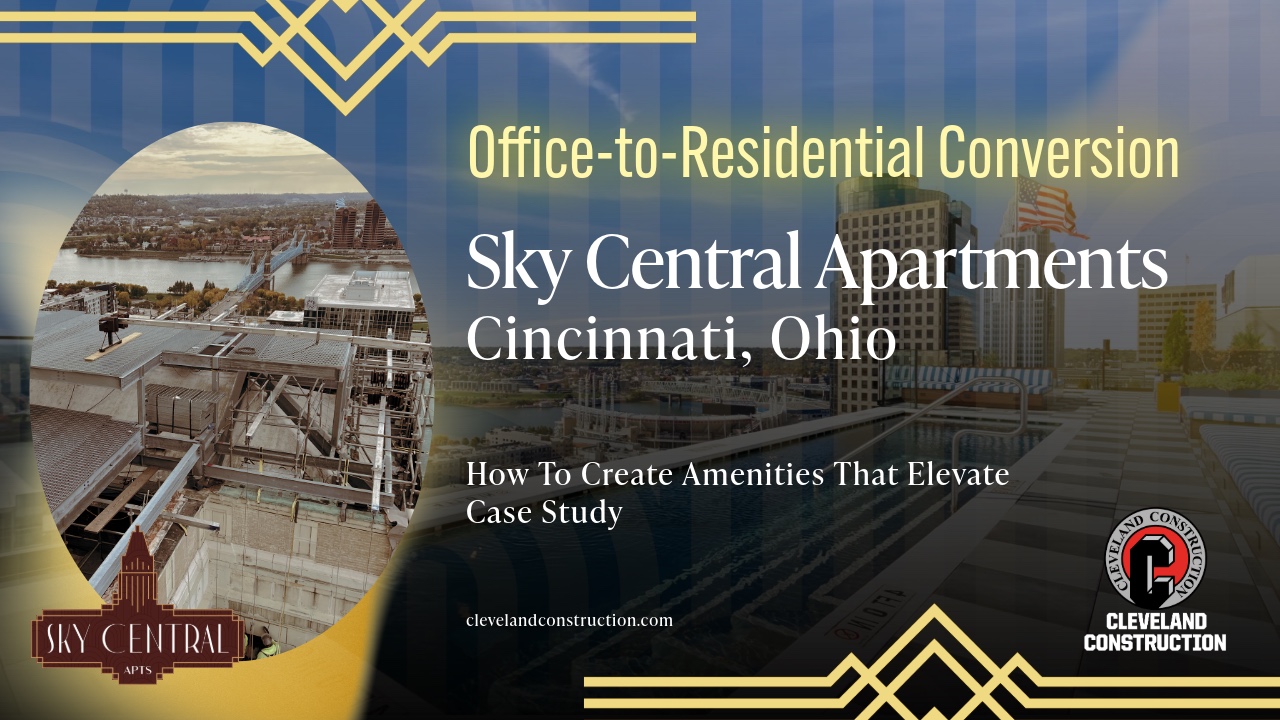
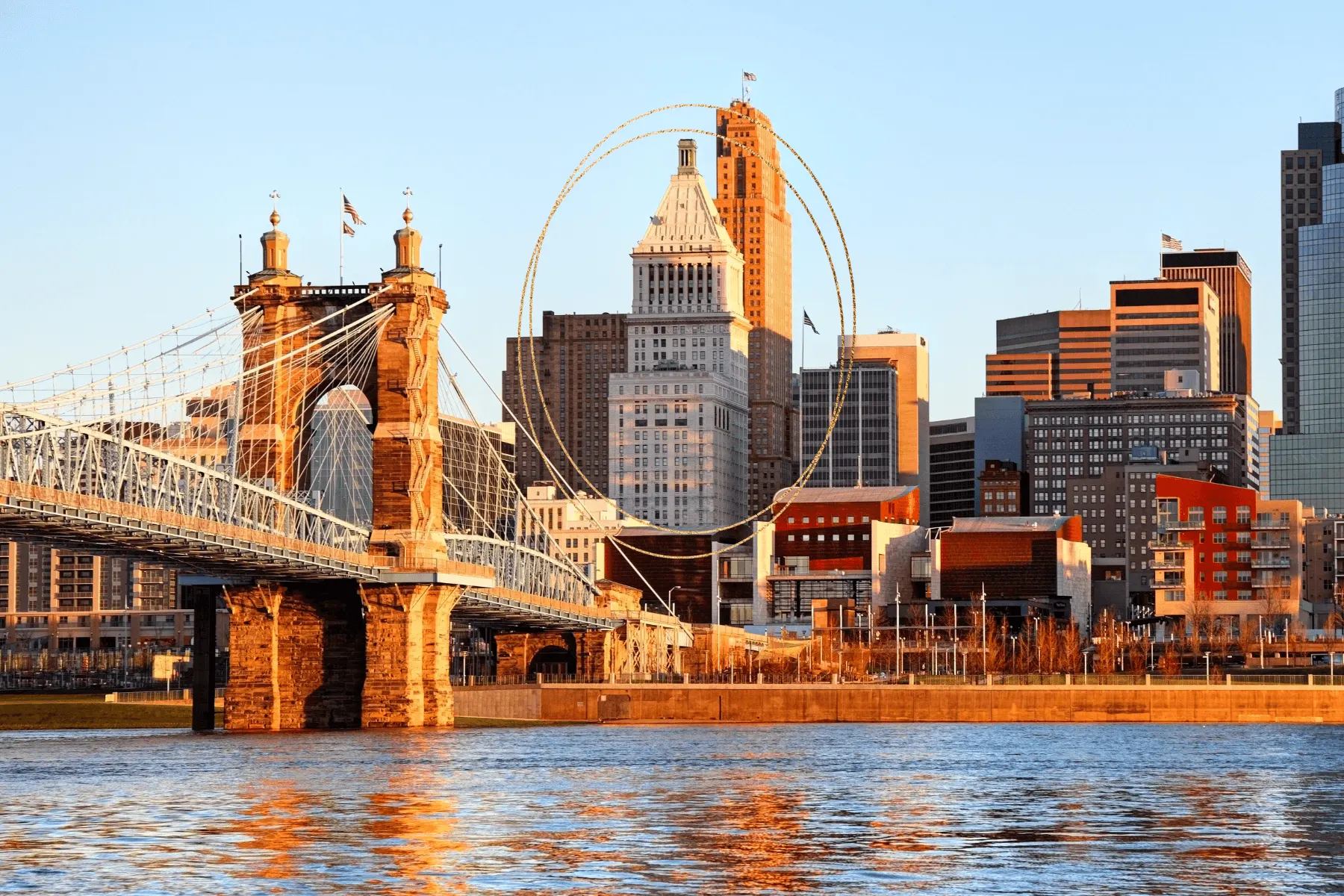
When Union Central Tower was built in downtown Cincinnati in 1913, it was the fifth tallest building in the world and the second tallest outside of New York. Soaring 31 stories and 412 feet high, the former PNC Building on the corner of Fourth and Vine became an iconic landmark in the city’s riverfront skyline.
Then, in May 2022, Cleveland Construction Inc. embarked on the historic renovation and adaptive reuse of the commercial office space. Tasked with transforming the tower into a mixed-use development rebranded as Sky Central, Cleveland Construction converted the building into 281 luxury apartments and penthouses surrounded by resort-class amenities. From the marble-clad, gold-trimmed lobby to the 19th-floor Sky Park featuring a rooftop pool, hot tub, sauna, and more, the extensive renovation maximized the tower’s historic charm while ushering in a new era of experiential living.
The extensive office-to-residential conversion required a full gut demolition of the building while preserving certain historic features and modernizing the mechanical shafts and systems within the existing floor plan. Throughout the project, challenges both big and small required strategic problem-solving from the construction team and its trade partners.
“In any historic renovation project, you will have challenges and you will need to adapt — whether it’s adjusting the schedule for a delay in drywall delivery or identifying unknown conditions that require collaboration with the design team,” said Cleveland Construction’s Cincinnati-based project manager, Chase Keller . “Unless you specialize in these difficult historic renovation projects, you don’t know what to expect. But if you’ve been through it before, you can plan for it and quickly overcome it.
Here’s how Cleveland Construction leveraged its construction management expertise to tackle these adaptive reuse challenges while reimagining the $90 million office-to-residential redevelopment.
Uncovering historic renovation challenges
Before kicking off this project, Cleveland Construction’s local team met with other executives throughout the company to review lessons learned from similar historic renovations. They discussed challenges such as:
-
Scheduling material deliveries to a confined construction site in a busy downtown location,
-
Coordinating the buck hoist elevator to efficiently transport workers and supplies, and
-
Identifying existing floor assemblies and exterior wall conditions in a historic building.
These early discussions prepared the project team for the challenges that lurked behind Sky Central’s historic façade.
For example, Cleveland Construction planned to preserve the building’s existing plaster walls. “However, when we started demolition, we found that the exterior wall conditions were not what we anticipated,” Keller said. “The plaster was peeling and dilapidated in some areas.”

By quickly identifying those conditions and presenting the owner with alternative solutions, Cleveland Construction maintained the project budget and schedule with a clever workaround: installing a thin furring channel of metal strips, creating a stable surface to attach drywall. “This maximized unit square footage without impacting the protruding reveal of the historic aluminum window trim, which was a requirement of the owner’s tax credit incentive,” Keller explained.
Inside the building, the existing flooring presented another challenge. Exploratory demolition revealed a terracotta speed block assembly, which relied on compression forces to preserve its structural stability. Penetrating those load-bearing assemblies to infill existing mechanical shafts or drill new shafts could jeopardize the entire system. To avoid any issues, Cleveland Construction collaborated with the structural engineer to install temporary shoring underneath each slab that could bolster the assembly until new steel supports were installed.
The biggest structural challenges emerged on the 19th-floor Sky Park, which featured a rooftop terrace with an infinity pool, hot tub, fireplace, grilling stations, outdoor kitchen, and Zen garden. “The pool deck was one of the most challenging aspects of this building,” Keller recalled. “As you think about how you’re going to put a pool 300 feet high on top of a historic plaster ceiling in a busy downtown corner, so many issues come to mind.
Crafting collaborative construction solutions
Tackling these rooftop challenges required early planning and ongoing collaboration. Cleveland Construction employed building information modeling (BIM) coordination that integrated architectural, structural, and MEP (mechanical, electrical, plumbing) disciplines into a unified 3D digital model. Weekly BIM coordination meetings kept the construction team, design team, and trade partners aligned, enabling early identification of potential risks to prevent problems on site.
The rooftop terrace was designed based on existing drawings, but it required careful field verification of every detail. Cleveland Construction brought trade partners on site early to verify dimensions and submit shop drawings for prompt design review and inspection approval, then maintained weekly collaboration during installation to quickly modify the design as needed.

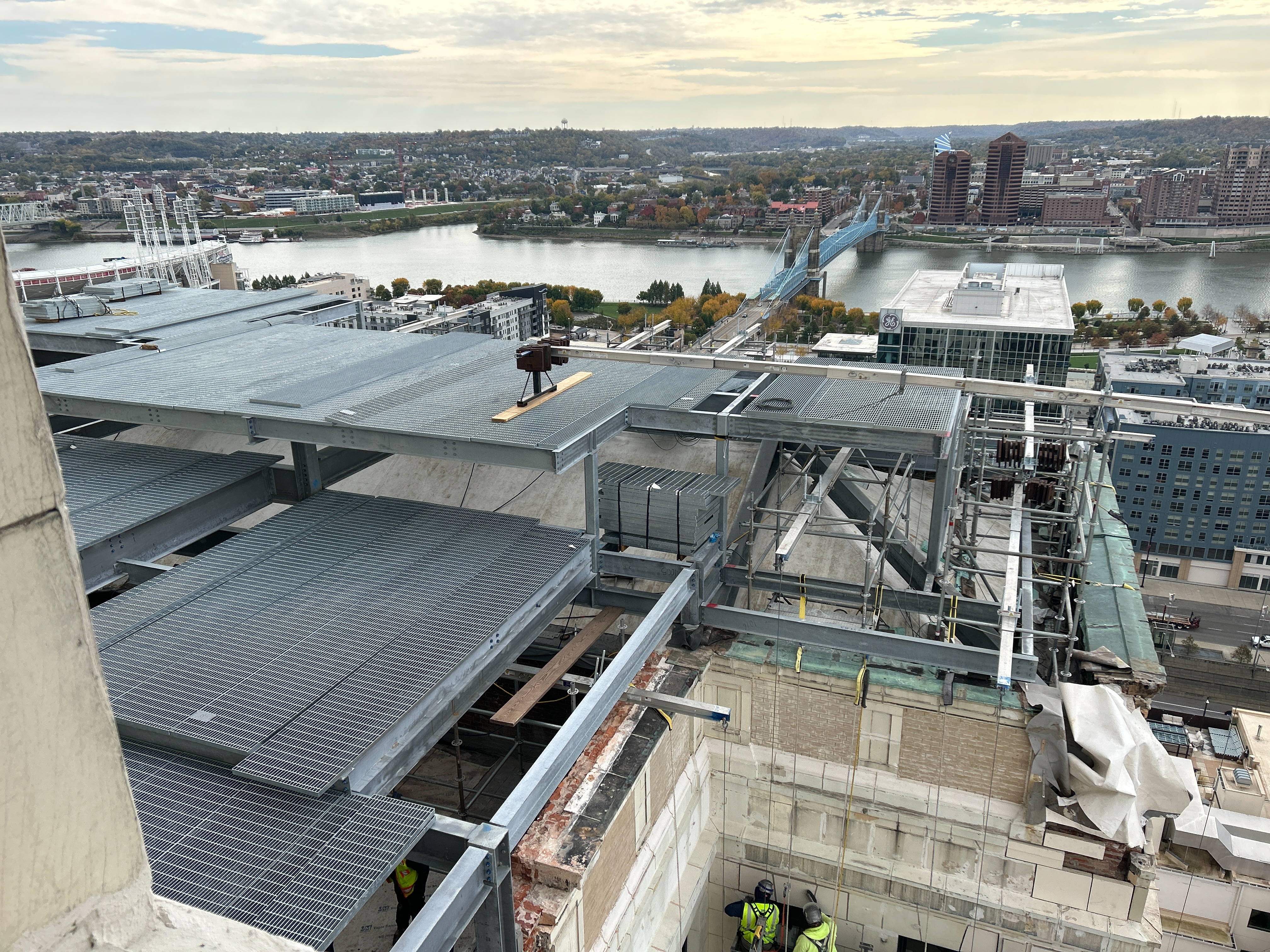
To reinforce the plaster roof, the team constructed a steel exoskeleton that followed the slope of the existing peaked roof, then covered that assembly with a flat structure that could support the weight of the 9,120-gallon pool, 1,300-gallon hot tub, and other rooftop amenities. The structural steel tied into existing column lines within the exterior walls, requiring selective removal of parapet masonry. Because this work introduced a high risk of water intrusion, each parapet penetration had to be enclosed daily and closely monitored with regular waterproofing inspections.
One of the biggest challenges on the pool deck wasn’t the pool itself, but the prefabricated planter boxes that had to be precisely measured and carefully installed to maintain specific ADA clearances throughout the walkways. Even a slight clash of two inches could throw the design out of compliance. “This was one of the most time-consuming portions of the project,” Keller said. “We met weekly, if not twice weekly, with our steel contractor, structural engineer, and landscape designer to review shop drawings and to ensure that the proper clearances were being maintained so that finishes could be installed properly.”
These rooftop hurdles demanded careful planning and keen delivery coordination to keep the project progressing on schedule. For example, installing one of the largest adiabatic chillers in North America above the fourth floor required that equipment delivery coincided with construction work on the fourth-floor Bark Park — while 27 floors of historic façade restoration were simultaneously happening above that.
To manage the sequence and scope of this work, the project team held a foreman’s meeting every morning to review the day’s deliveries and buck hoist schedule. “It’s one thing to get the material on site, but it’s another thing to get it to its final location,” Keller said. “So, not only do you have to coordinate who’s using the street access for deliveries, but you also have to coordinate who’s using the buck hoist. When you have 150 people on site constantly going up and down, it can impact the efficiency of the buck hoist.”
Early on, Cleveland Construction established “a culture of collaboration” between all the trade partners and subcontractors by scheduling use of the temporary buck hoist. As daily coordination plans shifted, walkie-talkies installed on each floor provided a direct line to the buck hoist operator to keep the vertical transport elevator running efficiently.
Unveiling the results of historic redevelopment

Walking into the main lobby of Sky Central today is like entering a time portal back to 1913, with immaculately preserved marble walls, gleaming bronze elevator doors, and refinished terrazzo floors. On the 19th-floor rooftop, the sleek multi-tiered pool deck offers crisp modern amenities that blend seamlessly into the building’s beautifully restored historic charm. Called “one of the most significant historical conversions in the U.S.,” not to mention one of Cincinnati’s largest apartment communities, the renowned adaptive reuse project highlights Cleveland Construction’s specialized craftsmanship and problem-solving savvy.

“Being from Cincinnati, I know how much this tower means to the city,” Keller said. “To be involved in the restoration of such a prominent building is extremely meaningful because we really care about the work that we do. A project with these unique historical aspects and complex challenges required a deep level of dedication, so we carefully selected local subcontractors and trusted trade partners to build a team dedicated to the success of this project.”

The key to executing a project of this scope, as with any complex adaptive reuse project, was adaptability. “You have to make sure every detail is thoroughly planned out, and then be able to quickly adapt and pivot,” Keller said.
The successful completion of Sky Central’s historic renovation in March 2026 reflects Cleveland Construction’s expertise navigating unforeseen challenges. This prowess, Keller noted, comes from the firm’s broad knowledge honed by years of experience tackling similar conversions around the country.
“When Cleveland Construction engages in a project like this, you don’t just get the local project staff that’s on site,” he said. “You get decades of experience and company-wide resources that are greater than the individual project team, and that’s what enables us to maintain a lot of success with historic redevelopments.”


